Lending Standards Are Not What They Were Before The Crash
Every month, the Mortgage Bankers Association (MBA) releases the Mortgage Credit Availability Index (MCAI). According to their website:
“The MCAI provides the only standardized quantitative index that is solely focused on mortgage credit. The MCAI is . . . a summary measure which indicates the availability of mortgage credit at a point in time.”
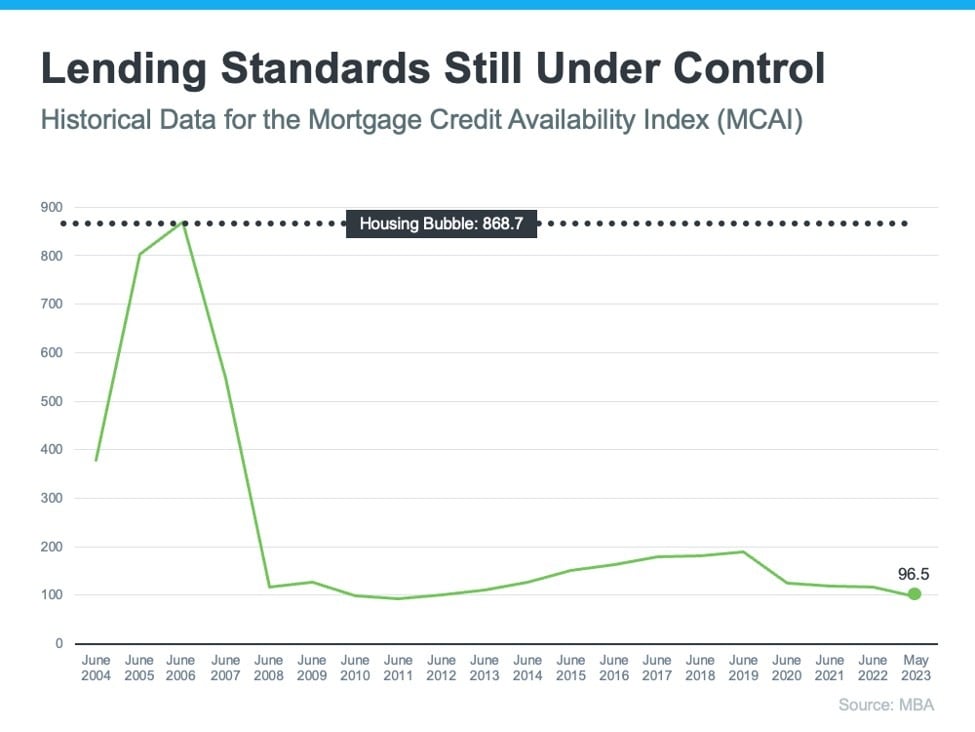
In basic terms, the index affects how easy it is to obtain a mortgage. Examine the graph below of the MCAI since they began tracking this data in 2004. It demonstrates how lending requirements have evolved throughout time. It works like this:
In 2004, the index was around 400. But, by 2006, gone up to over 850. But today, the story is a bit different. Since the crash, the index went down because of lending standards got tighter, so today it’s harder to get a mortgage.
The high peak in the graph above demonstrates that prior to the housing crisis, credit was considerably simpler to obtain, and loan criteria were not stringent. Credit was easily available at the time, and the qualification criterion for a loan was low.
Lenders were accepting loans without always conducting a verification process to determine whether the applicant would be able to repay the amount. This meant that creditors were financing to more borrowers who were more likely to default on their loans.
As previously stated, lending rules have evolved significantly since then. The following is how Bankrate characterizes the distinction:
“Today, lenders impose tough standards on borrowers – and those who are getting a mortgage overwhelmingly have excellent credit.”
Looking back at the graph, you'll observe that after the high around the time of the housing meltdown, the line indicating the index dropped drastically and has been low ever since. In fact, the line is far lower than it was even in 2004 - and it's getting lower. MBA's Joel Kan, VP and Deputy Chief Economist, presents the most recent May update:
“Mortgage credit availability decreased for the third consecutive month . . . With the decline in availability, the MCAI is now at its lowest level since January 2013.”
The declining score indicates that standards are becoming considerably stricter, indicating that we are far from the extreme lending practices that lead to the catastrophe.
Bottom Line
Prior to the housing catastrophe, lending standards were significantly more permissive, with little consideration given to borrowers' ability to repay their loans. Standards are now stricter, and the risk is lower for both lenders and borrowers. This demonstrates that these are two quite distinct housing markets and that this market is not like the last.
Call Teresa Ryan today, at (630) 276-7575 for all of your real estate needs!
Get a copy of our Home Buyer Guide written by Teresa Ryan for Chicagoland home buyers, visit: FREE Home Buyer's Guide
Whether you’re ready to buy your next home or considering selling your current one, we’re here to help. Complete the form below, and a member of our team will be in touch shortly to answer your questions and help you take the next step.
Work with a team backed by 25+ years of local experience, proven results, and a genuine commitment to every client relationship.

RYAN HILL GROUP
ADDRESS 1288 RICKERT DR STE 300 NAPERVILLE, IL 60540